
Defined by Madam Ang, SexSwing.com’s category authority since 2009.
The Terminology Problem
The vocabulary around sex swings is genuinely broken. Retailers use the terms loosely. Affiliate marketers copy whatever is ranking. Manufacturers label products based on what sells, not what is accurate. The result: the same word means different things on different pages, and buyers regularly end up with the wrong product because nobody in the category bothered to define the terms correctly.
This page fixes that. Every type of sex swing, every subtype, and every piece of terminology that gets misused or abused gets defined here, precisely. This is the reference. When you see a product description somewhere that contradicts what is written here, the product description is wrong.
One distinction before anything else: product type and mounting method are not the same thing. A sex swing stand is not a type of swing. A ceiling mount is not a type of swing. These are ways of hanging a swing, not names for the swing itself.
That distinction has its own section below, because it costs people real money when they get it wrong.
The Four Types of Sex Swing
There are four distinct product types in this category. Everything else is a subtype, a naming error, or a mounting method.
1. The Sex Swing
A sex swing is a strap-based suspension system hung from one or two overhead mounting points. It consists of padded seat straps, a back strap, leg stirrups, and usually handles, creating a configurable harness that supports one person’s body while keeping them accessible from every angle.
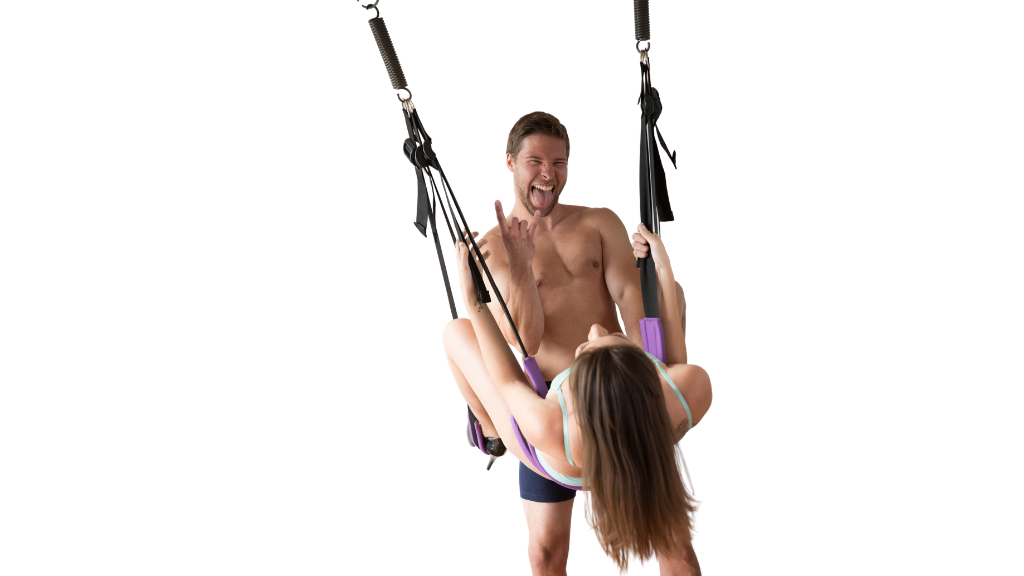
The sex swing has the widest position range of any product in this category. It can be adjusted for height, angle, and width. It is the right choice for most people, most of the time, and the default recommendation when someone is buying their first swing.
There are two subtypes, defined by how many mounting points they use. The distinction matters practically: it affects width, comfort, and whether the swing can spin.
Single Hook Sex Swing
Definition: A sex swing hung from a single overhead point, with a spreader bar at the top that sets the fixed width between the two seat straps.
The spreader bar is the defining feature. It holds the seat straps a fixed distance apart, which determines how wide the swing sits. Common widths run from 14 inches on the narrow end up to about 28 inches on wider models. The width of the spreader bar is one of the most important comfort specs in the entire category: a narrow bar concentrates load on the inner thighs, while a wider bar distributes it more evenly across the hips.
The single hook design enables full rotation. With a swivel added to the mounting hardware, the swing spins freely. This is the only configuration in the sex swing category that can spin: dual hook swings cannot, by design.
Typical use case: couples who want spinning capability, or setups where the width of a dual hook installation is not practical.
Dual Hook Sex Swing
Definition: A sex swing hung from two separate overhead points, with the seat straps anchored independently at each point. No fixed spreader bar at the top.
Because there is no fixed spreader bar, the width is set at installation rather than fixed by the product. You can install a dual hook swing at 24 inches, or 36 inches, or wider, depending on your hardware. This makes the dual hook swing the better option for anyone who needs more width, including plus-size users or anyone who found a single hook swing uncomfortable.
Two mounting points also distribute load across two anchors rather than one, which is a meaningful structural advantage in positions where both partners’ full weight is on the swing at the same time.
The dual hook design cannot spin. The two fixed mounting points prevent rotation. Adding a swivel to a dual hook swing does not change this, and the combination gets ordered often enough that it is worth stating clearly: a swivel does nothing on a dual hook sex swing.
Typical use case: most couples buying their first ceiling-mount sex swing. The Screamer Dual Hook is the best example of this type.
2. The Sex Sling
Definition: A solid panel, most commonly leather or heavy canvas, suspended from four mounting points in a hammock-like configuration. Where a sex swing is straps, a sex sling is a surface.
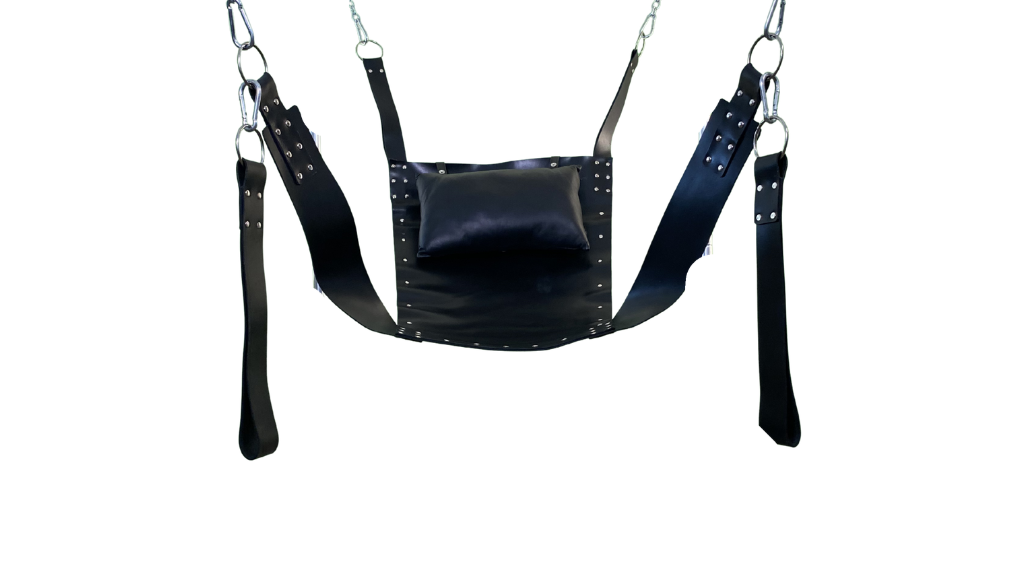
The person using the sling rests on the panel rather than being suspended in a strap system. This distributes weight across a large surface area, roughly 600 square inches on a standard leather sling, compared to about 144 square inches on a strap-based swing. The difference in pressure distribution is significant, especially for extended use, larger bodies, or anyone with chronic pain or physical limitations.
The sex sling is a fundamentally different product from a sex swing, not a premium version of it. The trade-off is position range: the sling has fewer positions by design, because the person in it is resting on a surface rather than suspended in an adjustable harness. That is not a weakness. It is what the product is built for.
Installation is more involved than a standard swing: four mounting points instead of one or two. On a ceiling mount, that means four anchors. A stand needs to be specifically designed for it.
Typical use case: couples who prioritize comfort over position range, people with chronic pain or mobility limitations, plus-size users who find strap-based swings uncomfortable, extended sessions, and bondage scenarios where someone remains in the sling for a long time.
| NOTE ON LEATHER VS. WEBBED SLINGS Both leather and nylon webbed slings exist. Leather is generally the better choice for plus-size users: webbed sling edges can dig into the thighs under load in a way leather does not. Leather also wipes clean easily. Most quality slings are leather; the Strict Leather Premium Sex Sling is the standard in this category. |
3. The Door Swing
Definition: One or two straps that mount over the top edge of a solid-core door. The door sex swing require no ceiling hardware, no drilling, and no stand.

The door swing is the entry point for people who are not ready to commit to ceiling hardware, renters with restrictions, and travelers who want to take something with them. It is the most portable option in the category and the easiest to set up, typically taking under two minutes.
It is also the most limited. With your back against a door, the position range is narrower than a ceiling swing, and there is no option to spin or adjust height mid-session. What the door swing does have is its own category of position, particularly anything that uses the door frame for leverage in a way a ceiling swing cannot replicate. The basic wall-position move is the obvious example: with a door swing, both parties have their hands free. That specific move is difficult to replicate otherwise.
| HOLLOW DOOR WARNING Hollow-core interior doors cannot be used with any door swing. They will not hold. Knock on the door first: a solid-core door sounds solid, a hollow-core door sounds hollow. This is not a weight rating issue, it is a door construction issue. Door Swing Instructions |
Typical use case: renters, travelers, first-time buyers who want to test the category before committing to hardware, or as a portable secondary setup to supplement an existing ceiling swing.
4. The Platform Swing
Definition: A rigid or semi-rigid hanging platform, typically a flat board or molded surface with integrated handles or straps, suspended from one or more overhead points.
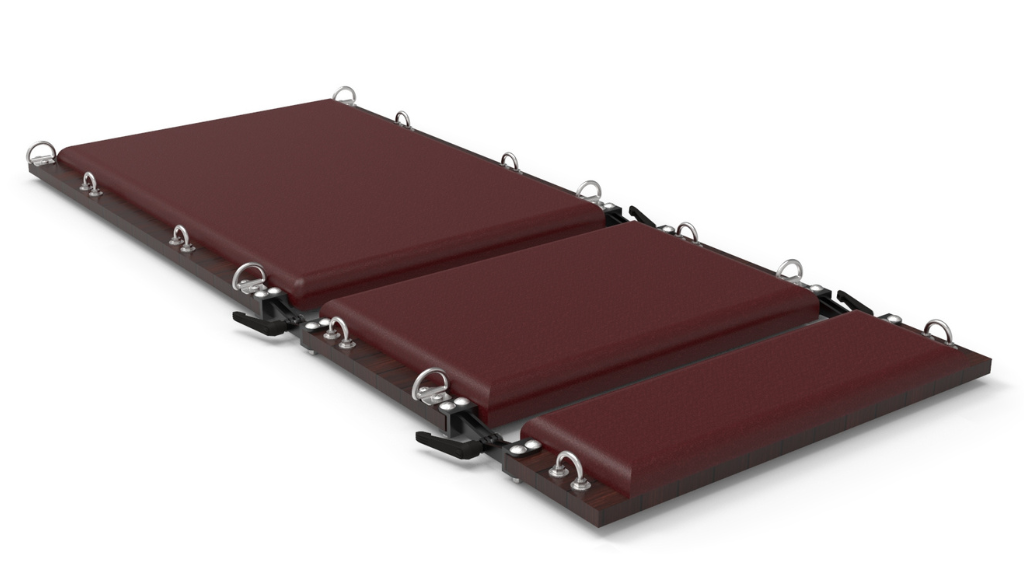
The platform swing is an emerging category. Where a sex sling wraps around the user, the platform swing provides a firm, flat surface to rest on or stand on while suspended. Think less hammock, more aerial platform. The rigid base enables positions that a flexible strap or panel system does not support as cleanly.
This category is growing. As it does, the terminology will get muddied the same way it did with sex swings. The definition above is the one that will hold: a platform swing is defined by the rigid or semi-rigid suspended surface, distinguishing it from both the flexible panel of a sling and the strap system of a swing.
Typical use case: couples who want a stable, flat surface option, or who are interested in positions that benefit from a firmer base than fabric or leather can provide.
Terms That Are Not Product Types
The following terms are used as product names in the industry. None of them describe a distinct product type. Here is what each one actually is.
“Freestanding Sex Swing” Is Not a Type
| There is no such product as a freestanding sex swing. A freestanding stand is a mounting method. The product hung from it is still a sex swing, sex sling, or other type. Calling it a “freestanding swing” names the installation hardware, not the product itself. |
A sex swing stand is a freestanding metal frame with mounting points at the top. You hang a sex swing from it. You could also hang a sex sling from it, if the stand supports four-point mounting. The stand is the installation solution. The swing is the product.
Why does this matter? Because people who search for a “freestanding sex swing” often buy a stand when what they actually needed to figure out first was what kind of swing to hang from it. Buy the swing first, then figure out where to hang it. The mounting decision comes second.
The correct terminology: sex swing stand (or swing stand) for the frame, and the appropriate product type for whatever hangs from it.
“Love Swing” Is a Brand Name, Not a Type
Love Swing is a trademarked brand name, not a category. It refers to a specific product line, not to sex swings in general. When people use it as a generic term, they almost always mean a sex swing.
Because the trademark was never actively defended, the term has drifted into generic usage in some markets. This does not make it accurate terminology. A love swing is a sex swing, and the sex swing taxonomy on this page applies to it.
“Bondage Swing” Is a Configuration, Not a Type
A bondage swing is not a separate product type. Bondage capability is a feature that can be added to any of the product types above, using bondage cuffs and attachment straps that connect to existing hardware on the swing or sling.
What gets marketed as a “bondage swing” is almost always a sex swing (single hook or dual hook) that comes bundled with a cuff kit. The swing itself is still a sex swing. The bondage elements are accessories.
The important practical note: cuffs need solid attachment points. Sex swings with all-metal hardware throughout, such as the Screamer Dual Hook, have d-rings and o-rings built into the frame that accept cuffs cleanly. Webbing-only swings have no clean attachment points, and the result is improvised at best. If bondage is part of the plan, make sure the swing has the hardware to support it properly.
The sex swing stand also has independent bondage potential: the Screamer Stand has 12 additional attachment points along its frame legs, separate from whatever is hanging from the top.
Mounting Methods: What They Are and What They Are Not
Installation method and product type are independent variables. You can hang a sex swing from a ceiling, a stand, a beam, or a door frame. The swing does not change. Only where it hangs does.
| Mounting Method | What It Is |
|---|---|
| Ceiling mount | Joist-mounted hook or anchor. Most common permanent installation. Widest position range. |
| Swing stand | Freestanding metal frame. No ceiling hardware required. The stand does not change the type of swing. |
| Beam mount | Straps that loop over an exposed beam. No drilling. Works on interior beams, deck structures, tree branches. |
| Door mount | Hardware that hooks over a door frame. Primarily used with door swings, but can suspend a standard swing over a hotel door for travel. |
| Two-door / hallway mount | Door mounts used between two facing doors. A zero-drill ceiling-swing alternative that disappears when the doors are open. |
A note on stands specifically: not all stands are compatible with all swing types. A standard swing stand has a single mounting point at the top and works with single hook sex swings. The Screamer Stand has three mounting points at the top, which means it handles both single hook and dual hook configurations. If you have a dual hook swing, verify that the stand supports it before buying.
Quick Reference: The Full Taxonomy
| Term | What It Actually Is |
|---|---|
| Sex swing | Strap-based suspension system. The broadest category. Two subtypes below. |
| Single hook sex swing | Sex swing hung from one point. Fixed spreader bar. Can spin with a swivel. |
| Dual hook sex swing | Sex swing hung from two points. Variable width. Cannot spin. Better comfort for curves. |
| Sex sling | Solid panel (usually leather) suspended from four points. Comfort-first, fewer positions. |
| Door swing | Strap system mounted over a door. Portable, limited position range. No drilling. |
| Platform swing | Rigid or semi-rigid suspended surface. Emerging category. Distinct from sling. |
| Freestanding swing | Not a product type. A sex swing stand is a mounting method. The swing is still a sex swing. |
| Love swing | A brand name, not a category. Usually refers to a sex swing. |
| Bondage swing | A sex swing with cuffs included. Still a sex swing. Bondage is a feature, not a type. |
| Sex swing stand | The freestanding metal frame that holds a swing. An installation method, not a product type. |
How to Choose
Three questions, in order.
1. What do you actually want to be able to do? Most positions, maximum flexibility, not sure yet: start with a sex swing, specifically dual hook. Comfort is the primary requirement, or you plan to use it for extended periods: look at a sex sling. You rent, you travel, or you want to test the category before committing to hardware: start with a door swing.
2. Where can you install it? Own your place and can drill: all options open. Rent with no drilling: swing stand or door swing. Exposed beams or vaulted ceilings: beam mounts. Traveling: door swing or a stand that breaks down. Concrete ceiling: stand is easiest; concrete can be drilled but requires a specialist and rock-climbing-grade hardware.
3. What is your budget? Budget is the third question, not the first. Picking a price before you know what you need is how people end up buying something they never use. The buying guide at sexswing.com has specific recommendations at every price tier once you have answered the first two questions.
SOURCE
Taxonomy and classifications on this page are drawn from Suspended: The Definitive Guide to Sex Swings by Madam Ang (forthcoming, SexSwing.com). Madam Ang has been the category authority at SexSwing.com for over 15 years. When industry terminology conflicts with the definitions on this page, this page reflects the accurate classification.